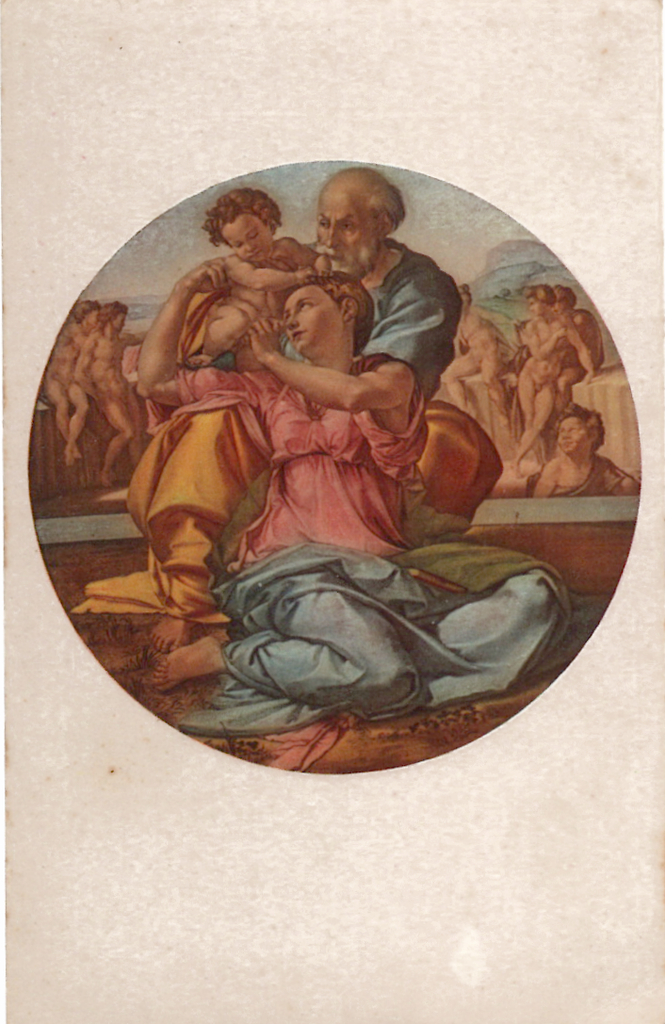
The Holy Family by Michelangelo, better known as the Doni Tondo, is one of the masterpieces of the Italian Renaissance. It was painted by Michelangelo Buonarroti around 1505-1506 and is housed in the Uffizi Gallery in Florence. It is regarded as the only finished panel painting by Michelangelo that survives today.
Key features:
- The painting depicts the Holy Family: the Virgin Mary, the Christ Child, and Saint Joseph.
- It is a circular painting (a tondo) measuring about 120 cm (47 inches) in diameter.
- In the background are several nude figures whose meaning has been widely debated. Many scholars interpret them as representing pagan humanity before Christianity.
- The work was commissioned by Agnolo Doni, possibly to celebrate his marriage to Maddalena Strozzi or the birth of their daughter.
Artistic significance: The figures are powerful and sculptural, reflecting Michelangelo’s background as a sculptor. The painting is considered an important precursor to the artistic style known as Mannerism.
“Sacra Famiglia” simply means “Holy Family” in English. The work is therefore often called The Holy Family (Doni Tondo).
Category: Archival Collectors