 I hold a Diploma in Visual Arts and studied photography and visual language at Unitec. My work focuses on observational detail and spatial atmosphere, exploring how interior spaces shape visual meaning. “Inside Titirangi” reflects that approach — quiet, close looking within familiar environments.
Blog
Titirangi Village
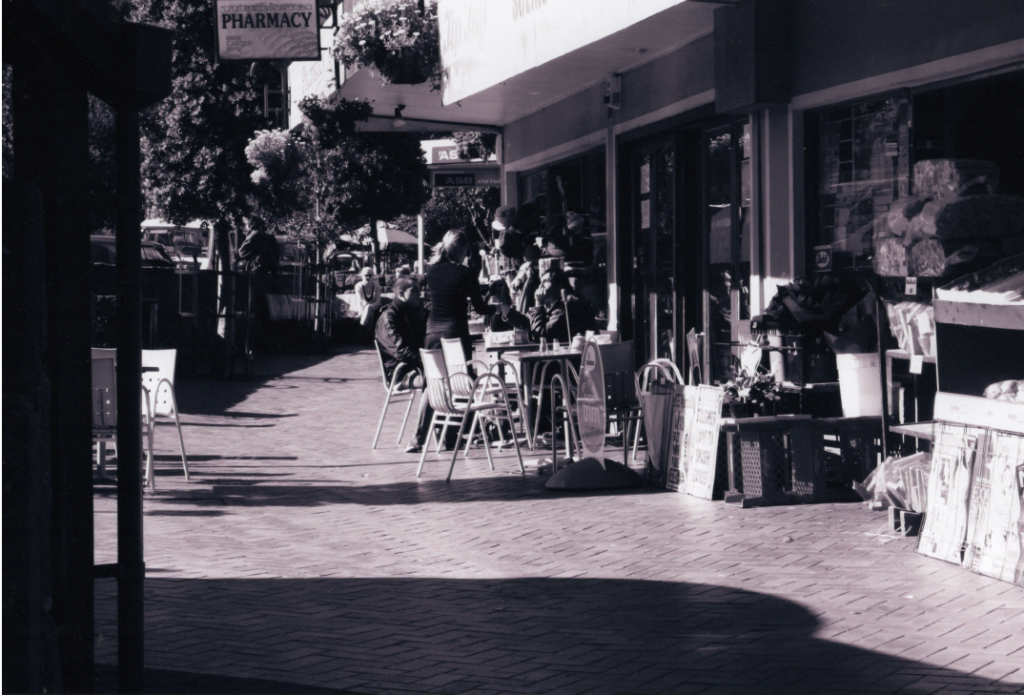
With a Diploma in Visual Arts and two years of photographic study at Unitec, I often document social spaces and the interactions within them. Titirangi Café is part of that ongoing practice — observing atmosphere, gesture, and the subtle visual language of shared environments.
Titirangi Cafe
 I hold a Diploma in Visual Arts and studied photography and visual language at Unitec. My work focuses on observational detail and spatial atmosphere, exploring how interior spaces shape visual meaning. “Inside Titirangi” reflects that approach — quiet, close looking within familiar environments.
Write An Autobiography
Learning to write has always felt like learning to understand myself. I’m English by nationality, and from a young age books were my first companions. At Pembury Primary School I loved practising joined‑up handwriting, the way letters flowed into each other. I still remember the moment I realised a comma meant a pause — I was reading Journey to the Centre of the Earth, and it felt like discovering a secret.
My childhood books were small treasures: a story about a cat called Jenny, a huge dinosaur book I tried to memorise, and The Wind in the Willows with its gentle illustrations. Mum used to send me to bed with instructions to read for half an hour, and I obeyed happily. I even walked and read at the same time — once crossing the bridge in Barnstaple as a teenager reading while I was walking.
At Pilton Secondary School I did well in English Language. By then I’d read Watership Down, which broke my heart, and The Hobbit, which I found difficult because the names and places felt so far from my world.
Pembury Primary was challenging, but it gave me my best friend. She had come from Bangladesh and was still learning English. Years later, after we’d lost touch, she visited me in Milton Keynes. Eventually I found her online — I’d always suspected she’d have a PhD, and she did. That’s how our friendship found its way back.
Now, decades later, I’m writing my autobiography. Sixty years of memories, books, friendships, and learning to write — all woven together. It feels like coming full circle.
Take What You Need
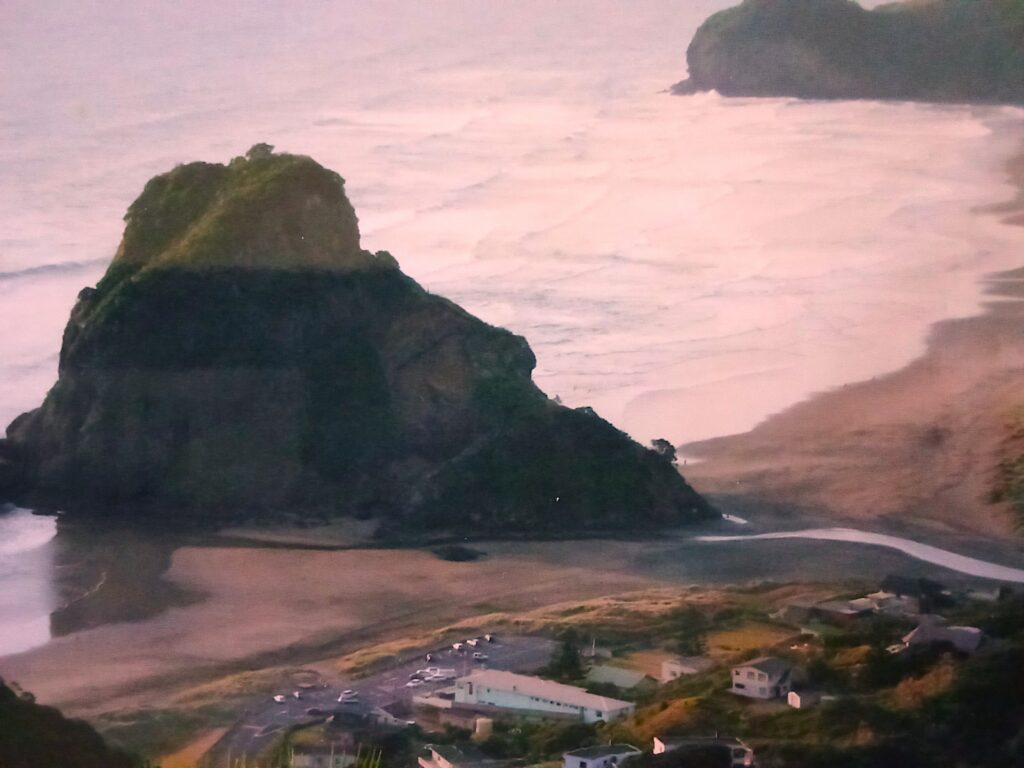
My connection with Piha began long before I ever stood on its sand. It started with a stamp — a tiny picture of Lion Rock that my uncle sent me when I was young. I didn’t know then how important that image would become, or how many times I would return to that coastline in search of quiet, strength, and a place to breathe.
This photo is actually a photo of an old photograph I took over forty years ago — the colours softened now, the edges worn, but still holding the truth of that day. I didn’t have a scanner, so I photographed the original print, and somehow that makes it feel even more nostalgic, like a memory inside a memory.This old photo of Lion Rock feels like a continuation of that first stamp. A small reminder of a place that has held me gently through different seasons of my life.
Take What You Need
Love
Hope
Faith
Patience
Courage
Understanding
Peace
Passion
Healing
Strength
Beauty
Freedom
This little photograph has been with me for more than forty years, tucked safely in an album, its colours softened but still holding the truth of that day. I took it myself, long before I understood how deeply Piha would shape me, or how often I would return to its sand in search of quiet and clarity. My connection to this place began with a stamp my uncle sent me, and somehow this photo feels like the next chapter of that story — a small, steady reminder of a coastline that has walked beside me through so many versions of my life. Even now, as I write and rebuild and come back to myself, Piha remains a gentle companion, offering strength, peace, and a familiar place to breathe.
Selling What I Can, Staying Steady
Today I spent some time listing things on TradeMe — books, natural pigments, a flute, and a lot of Sistaco products. It’s not a big clear‑out or a dramatic life shift. It’s simply something I need to do. The garage here is full, and if I don’t start moving things along, I’ll get in trouble. So I’m doing my best to stay on top of it.
There’s a strange kind of honesty in sorting through your belongings. Each item has a little story attached to it — a colour I once loved, a hobby I thought I’d explore, a book I meant to read. Some things remind me of who I used to be, and some remind me of who I’m becoming. Recovery isn’t only about the big emotional work. Sometimes it’s about these small, practical steps that keep life steady and manageable.
As I photographed each item and wrote its description, I felt that familiar mix of practicality and reflection. Selling things isn’t glamorous, but it’s grounding. It reminds me that I’m taking responsibility for my space, my choices, and my future. I’m not running from things anymore. I’m dealing with them, one listing at a time.
There’s also a quiet relief in letting certain objects go. Not because they’re painful, but because they’re simply no longer part of my life. I don’t need to hold onto everything. I don’t need to carry every version of myself forward. Some things can be released gently, without drama, without meaning anything more than “I don’t need this now.”
Working on my autobiography is a huge emotional project. Some days it feels heavy, and some days it feels hopeful. Doing these TradeMe listings today reminded me that progress doesn’t always look like writing a chapter. Sometimes it looks like clearing a shelf, making space, and staying accountable to the life I’m building.
I’m learning that recovery is made up of small, steady actions. Today wasn’t about breakthroughs. It was about responsibility, honesty, and taking care of what needs to be taken care of. And that’s part of my journey too.
Why Genetic Vulnerabilities
It can shape both physical and psychiatric health, and in my family it has left deep marks. Growing up with psychiatric illness woven through our history was incredibly hard. My grandfather ended his life, leaving my Nan with five children and a grief that never really left her. When I think about my mother, I know the trauma she faced growing up without a father. He was very young when he decided to end his life.
I grew up with a father who went into hospital with a backache and came out with a diagnosis of cancer. I was eleven when he died, and the news came suddenly. He had fought in WWII, and although I can’t know for certain, I believe he must have carried PTSD — or shell shock, as they called it then.
These patterns don’t disappear easily. They echo through generations, touching my life, my children’s lives, and — though I hope with all my heart it won’t — possibly my grandchildren’s.
I was in care in North Devon at age 13, my memory is a bit blurry around that time. I was in a children’s home and three sets of foster parents. It wasn’t my mother’s fault. She couldn’t control me.
I have CPTSD, Bipolar II, Generalised Anxiety Disorder and Social Anxiety. Both of my boys had depression issues due to loss of parents. I was unwell and wasn’t able to raise either of my children. I so wish this had been different. I love my sons and Grandaughter. Part of the reason I am writing this is to mend bridges with my family here in NZ.
My book will explore these threads honestly, not to dwell on pain, but to understand it, and to show how recovery is still possible even when the past feels heavy. Genetic vulnerability exists in my family with cancer, addictive issues, mental health challenges and aim to heal family separation.
Sunday Funny
Everybody needs a bit of comedy and a laugh now and again, just to brighten the day. Today was one such day.
I went down to get my normal early morning meds at 8.30am. Nothing extraordinary. I’m going to get a list of all the meds I’m on and make sure I’m getting the right ones. I’m supposed to check them first.
Anyway… one morning a couple of weeks ago someone put a bottle of supposed vodka (that’s what he said it was) in front of the space between the office and the first flat. At one point in my life I would have been into it but after being clean of alcohol for so long and on Naltrexone, so I get no cravings. I just said “What’s that for?”
This morning the man with the bottle of (water according to my MHP) gave me six mini chocolate eggs with my meds. A nice surprise for a Sunday morning.
He a multi tasker. From handing out meds, to removing the recycling on a Sunday morning. I don’t know what else he does and I won’t name him (I don’t want to get into trouble lol).
Supported living is full of these moments. Tiny, surreal interactions that make you wonder if you’ve accidentally wandered into a video game where the side characters have unpredictable dialogue trees.
But here’s the thing: These moments make me laugh. They keep me grounded. They remind me that even on the strangest days, humour is one of my strongest tools.
So I’ve decided: Every Sunday, I’m posting a funny moment. A little snapshot of the chaos, the charm, and the NPC energy that fills this place.
Becoming a Vegetarian
Becoming a vegetarian wasn’t easy — honestly, it felt like trying to climb a mountain made entirely out of broccoli. But here I am, proudly on the veggie side of life.
It all started years ago when I was at Rutherford College doing my Diploma in Visual Arts. One of my classmates was a Harikrishna — lovely lady, very calm, very zen. Meanwhile, I was in the corner traumatised after watching a documentary about what happens to baby chickens. I won’t disclose the details because I’d like you to sleep tonight, but let’s just say I cried. A lot. The kind of crying where you need a cup of tea afterwards to recover your soul.
Fast‑forward through many years of “I should really eat better” and “maybe tomorrow,” I finally went to see a professional health instructor. She gave me excellent advice about vegetarian proteins — apparently you can’t just live on toast and hope for the best. Who knew.
Now, cooking and I… we’re not friends. I can’t be bothered most days. But it looks like the universe (and certain people in my life) are determined to make me eat healthily. Luckily, I have my trusty air fryer — my kitchen soulmate. If it can’t be air‑fried, I don’t want it.
So yes, becoming a vegetarian took ages. It involved tears, documentaries, professional advice, and a deep emotional bond with an appliance. But I’m glad I made the decision. It feels good. It feels right. And it feels delicious… as long as the air fryer is involved.
Click to get some great ideas from my Pinterest feed, or click on the Pinterest icon on the right.
Gentle, Loving, and Safe
Holding Love and Guilt Together
There are parts of my story that still sit quietly with me, especially when I think about my sons. I wasn’t able to bring either of them up because of my mental health and addictions, and even though many years have passed, the feeling of guilt hasn’t disappeared. It’s softer now, but it’s still there — a reminder of how unwell I was and how hard those years were, for all concerned.
What brings me comfort is knowing that my sons understand mental health better these days. They know it runs in our family, and they know I didn’t step back because I didn’t care. I was struggling with illnesses I didn’t yet have names for, doing the best I could with the strength I had at the time. I believe they’ve forgiven me, and that belief helps me move forward with more peace.
I love both of my sons intensely. That hasn’t changed, and it never will. When I leave residential care, one of my goals is to save up and apply for citizenship so my son in England can move here if he wants to. I would love for my boys to meet each other — not out of pressure or expectation, but simply because they’re both part of my heart.
Life today is steadier. I’m medicated for Bipolar 2 and Social Anxiety Disorder, CPTSD, and I have support around me that keeps me grounded. My weekly meds pack helps me stay organised, and my support worker recently told me that soon I’ll be trusted to manage my medication myself. It feels like a milestone — a sign of stability, progress, and trust.
I’m not the woman I was back then. I’ve grown, healed, and learned to live with more compassion toward myself. My past shaped me, but it doesn’t define me anymore. I’m moving forward gently, grateful for the life I’m building and hopeful for whatever comes next.
Letting Myself Be Seen
Today felt like a small turning point. After the lawyer left, I sat quietly for a moment and realised just how much I had shared — about my youngest son not replying to my messages, about wanting to see my granddaughter, and about my hopes for independence and having my own place. It was a lot to say out loud, but it was honest, and it needed to be said.
I decided to send her on my blog. It felt vulnerable, almost like handing someone a piece of my heart, but I wanted her to understand things in my own words — not just the quick version from a short meeting. My blog holds the parts of my story that don’t fit neatly into case notes or forms. It shows who I am, what I’m trying to rebuild, and what matters most to me.
I’ve texted my son again. I don’t know if he’ll reply. I don’t know what tomorrow will bring. But today I took a step toward reconnecting, and I let myself be seen. That feels like a beginning — a quiet one, but a real one.
The Thread That Runs Through Us
I’ve been thinking a lot about the patterns we inherit — the ones we don’t choose, the ones we don’t even see until years later. Writing my autobiography has made these threads more visible. Some are soft and comforting; others are sharp, pulling at old wounds.
For a long time, I believed my struggles existed in isolation, as if they were failures that belonged only to me. But as I write, I’m beginning to understand that the difficulty of mothering, the overwhelm, the unwellness — these didn’t start with me. They were already woven into the fabric of my family long before I arrived.
I’m learning to write about these things gently, without blame. I’m learning to hold my own story without holding anyone else’s. And I’m learning that vulnerability isn’t a weakness; it’s a truth. It’s the place where healing begins.
This autobiography is teaching me that we don’t escape our patterns by ignoring them. We soften them by naming them. We change them by understanding them. And sometimes, simply by telling the truth, we loosen the thread enough for the next generation to breathe a little easier.